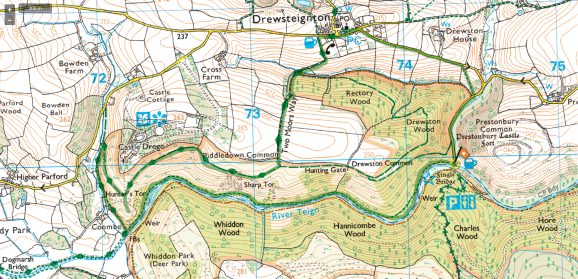
This first in a series of church-themed “Over the Hill Hikes” (OTHHs) on Dartmoor gives a new twist to a classic walk around the Castle Drogo estate, by extending the walk to visit the captivating old village of Drewsteignton and its 15th century church.
| WALK | A picturesque circuit with sustained interest. Following a beautiful stretch of the River Teign before climbing to join a high-level path giving expansive views towards Dartmoor and down the Teign Gorge – with an optional diversion to visit Castle Drogo – before visiting Drewsteignton and its captivating church. |
| START /FINISH | Fingle Bridge (SX 743900). There is roadside parking beside the road leading down to the bridge and further parking on the other side of the river. |
| DISTANCE | 5 Miles (without the diversion to Castle Drogo, which adds a mile or so) |
| ASCENT | 1,217ft |
| TERRAIN | Good paths throughout, with a little unavoidable road walking to complete the circuit. There are two significant ascents; after leaving the riverside path to climb to Hunters Tor (a long zig-zag eases the gradient nicely) and a steep climb after leaving the Hunters Path and a steep climb to reach Drewsteignton. There is also a rocky outcrop to overcome, with handrails, on the fisherman’s path |
| PUB | Fingle Bridge Inn (or The Drewe Arms when it re-opens) |
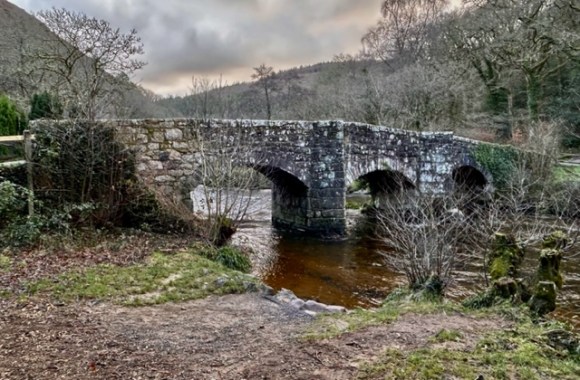
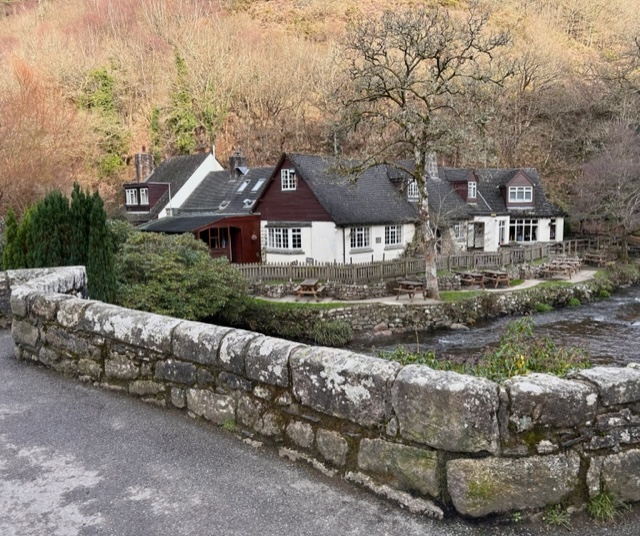
Before setting off, you’ll want to have a look at the old pack-horse bridge, just wide enough for a horse and cart, that crosses the River Teign. In his “Dartmoor Companion”, George Thurlow describes this delightful spot as “one of those places where a bridge fits so naturally into an enclosing landscape”.
After taking a picture or two, return to the inn and follow a path, s/p “Fisherman’s Path” that wends its way along the riverbank. This path is part of the Dartmoor Way, an 84 mile long footpath circumnavigating the moor and passing through several towns and villages around its border. It is also know as the Fisherman’s Path as it crosses the Castle Drogo estate.
Whatever you decide to call the path, it is a delight to walk on as it takes us through a gorge of ancient woodland and showcases some of the most sensational scenery in Devon.
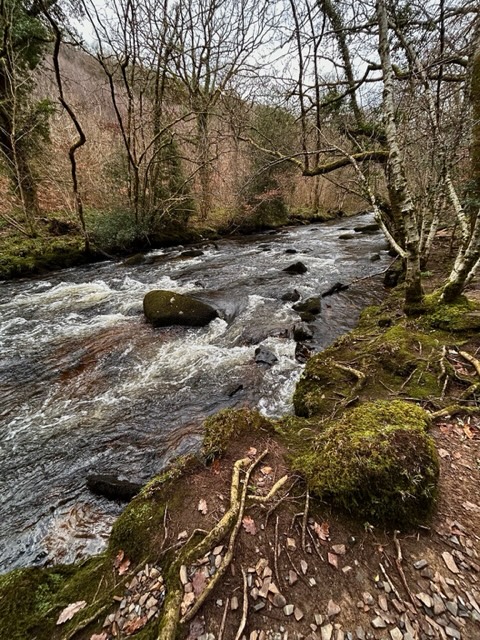
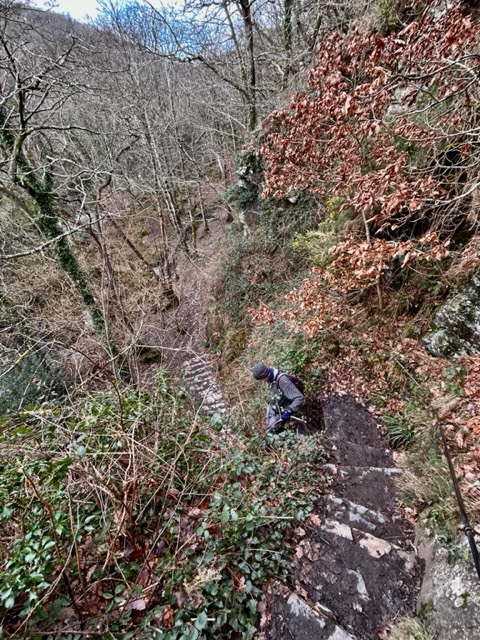
Along the first section of the Fisherman’s Path, the river tumbles wildly and very attractively over huge boulders before steering a more tranquil course. The path gently undulates along the riverbank and there is just one steep section, where it climbs over a rocky outcrop to descend sharply on the other side. The National Trust have thoughtfully provided handrails to help us overcome this obstruction without much difficulty.
You may be surprised to pass a rather incongruent hydro-electric power plant and weir (SX 723896). This was installed when Castle Drogo was built in the 1920’s but fell into disuse until recently renovated by the National Trust: it now once again meets some of the castle’s electricity needs.
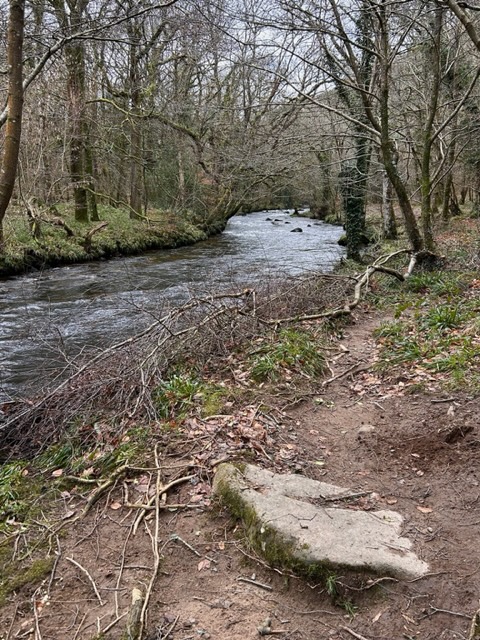
At a bridge (SX722895) turn right s/p “Hunter’s Path and road nr Castle Drogo” to follow a gently rising, well-made path. You are now on the “Two Moors Way”, a long-distance trail originally linking Ivybridge in the south of the moor with Lynmouth on the north Devon coast, 102 miles away. Since its inception it’s been extended to Wembury on the south Devon coast to create a 116-mile-long coast to coast path. There are now also several variants on the original route.
For the next few miles the Two Moors Way shares the path with the Mary Michael Pilgrims Way, part of an ambitious projected pilgrim route from West Cornwall to Norfolk, connecting significant Christian and pre-Christian sites. So far a route has been established from near Land’s End in Cornwall to Avebury in Wiltshire, 350 miles away.
Continue gradually upward on the two ways until a clear path takes a sharp U turn to the right towards Castle Drogo (SX 720901). For the next few miles, the path is so good they named it not twice, but three times, as it acquires a third name, the Hunters Path as it gradually climbs before levelling out to traverse high above the valley, just below Castle Drogo.
The imposing bulk of the castle is now spotted looming above us through the trees on our left, but before having to decide whether to visit the castle we have another treat in store – a diversion to Hunters Tor. To visit this excellent viewpoint over the Teign Gorge turn right at a T junction and sign post (SX722898). After admiring the expansive view from the tor, return the way you came to continue ahead on the Hunters Path, s/p Castle Drogo.
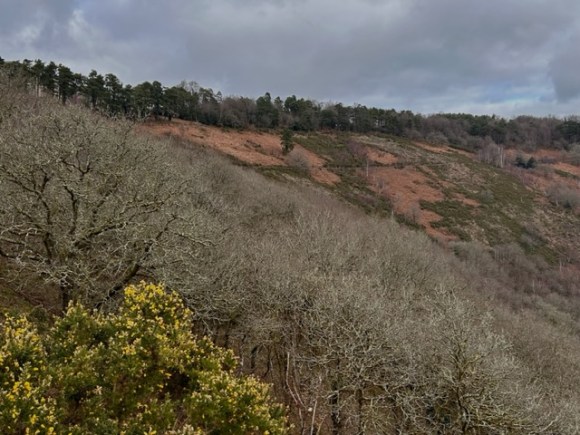
There now follows an exhilarating, spectacular walk along this high-level terrace above the Teign Valley, giving stunning views throughout and passing Sharp Tor (SX729899) where the National Trust have placed a bench to provide a superb lunch spot. In his “A Perambulation of Dartmoor” Samuel Rowe describes the view of Sharp Tor from the valley thus;
High in the abrupt declivity, two bold cliffs will be observed, jutting out from the hill, like the ramparts of a redoubt, guarding the narrow pass below.

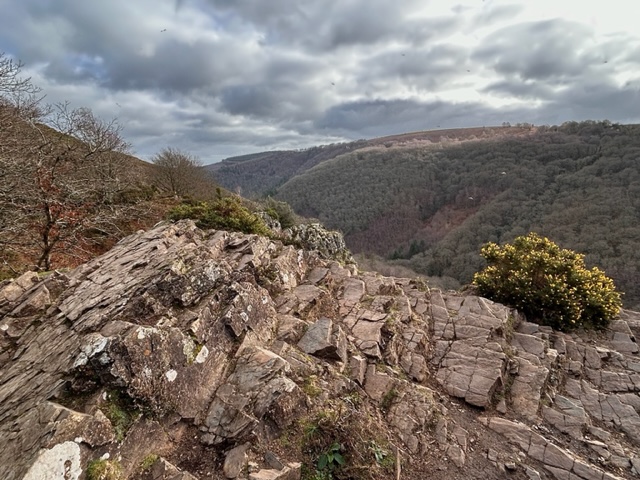
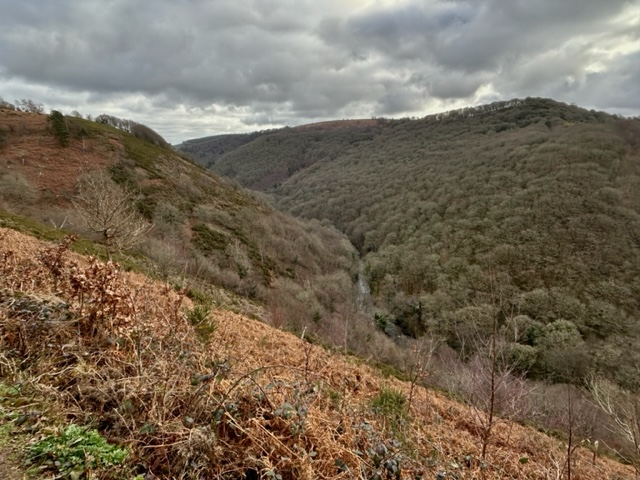
Castle Drogo, Sharp Tor and the Teign Valley from the Hunters Path.
From the top of Rowe’s “redoubt” continue along the Hunters Path to a sign post on your left (SX 728899) offering a diversion to the castle.
Castle Drogo was the last castle to be built in England, commissioned by Julius Drewe, founder of the “Home and Colonial” grocery stores and designed by Edward Lutyens. It is regarded as one of the celebrated architect’s finest buildings. The castle, along with its 1,500-acre estate, was given to the National Trust in 1974, the first 20th century property that it acquired. It has recently undergone major renovation and is well worth a visit, along with its lovely gardens and excellent café.
Back on the Hunters path, we follow it for a short distance until it starts descending to Fingle Bridge (SX 732900), here we turn left to follow the combined Two Moors Way and Mary Michael Pilgrims Way. Almost immediately the main path veers left, but we keep straight ahead (SX 732900) to go through a gate into a field before climbing slightly then descending into a valley along the western edge of Rectory Wood. We cross a stream in the valley bottom and continue steeply uphill to Drewsteignton.
Drewsteignton was listed in the Doomsday book, but there’s been a settlement in these parts since well before then: going back to Neolithic times in fact, as is evidenced by the rock burial chamber at Spinsters Rock (SX704908), the best surviving example of a prehistoric burial chamber on Dartmoor. Later on, an Iron Age hill fort was established at Prestonbury Castle (SX747900), which occupies a hill above Fingle Bridge.
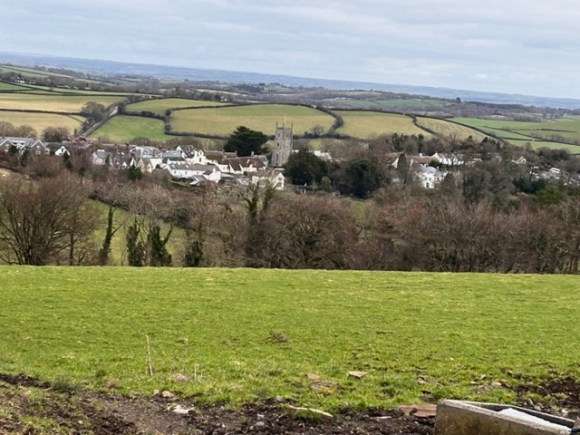
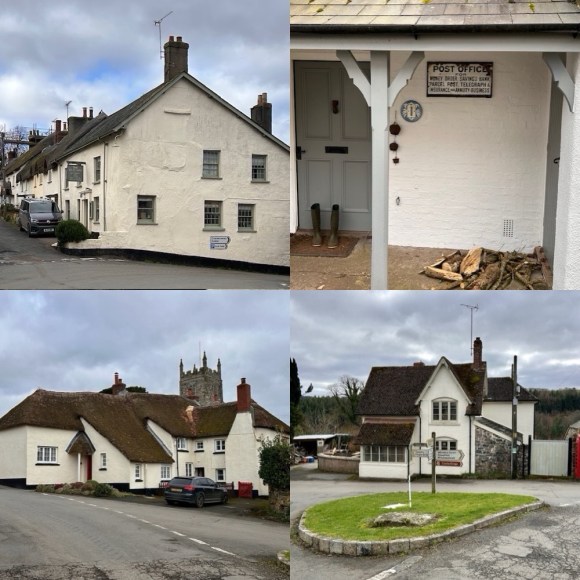
Today the village contains many attractive granite buildings, some dating back to medieval times, when it was a prosperous wool-producing centre. Unlike some Dartmoor villages it seems very much “alive” and thriving, with its well-stocked village store, post office, church and pub.
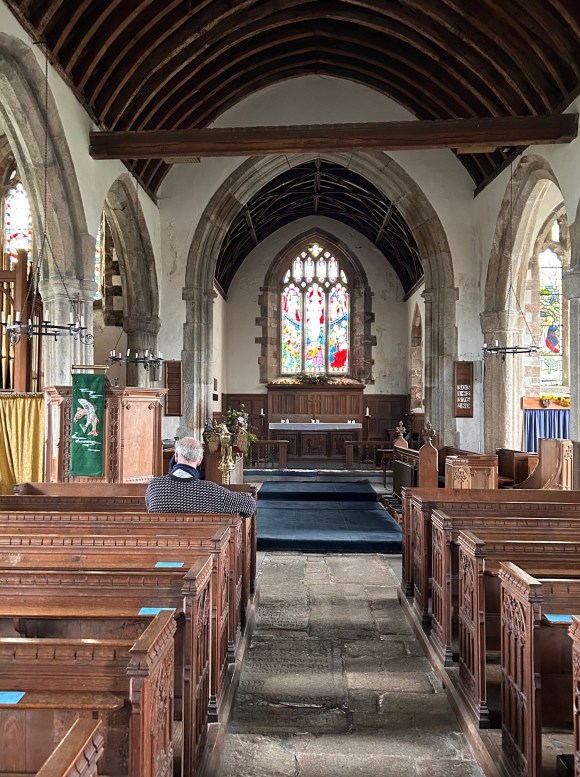
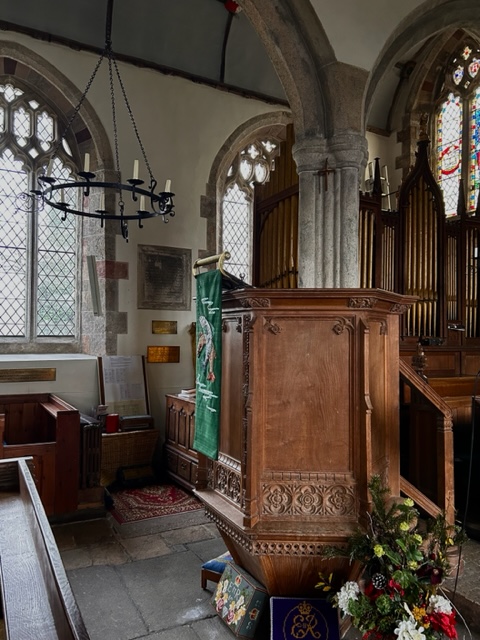
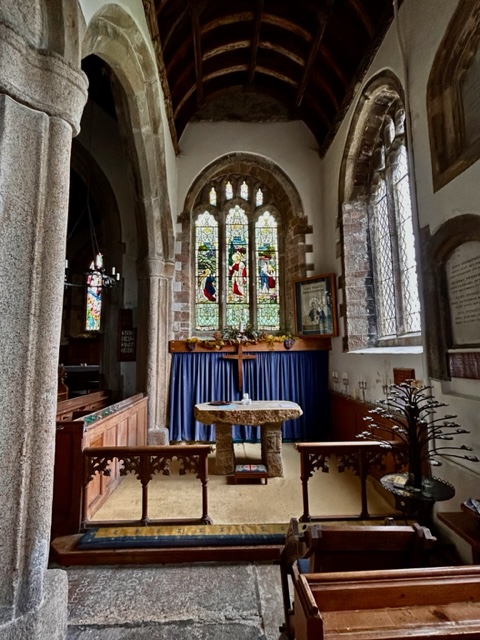
The Grade 1 listed Holy Trinity Church dates from the 15th and 16th centuries and is undoubtedly the centre-piece of the village. Its atmospheric interior boasts colourful stained-glass windows and attractive furnishings, particularly the pews with their carved bench-ends, added relatively recently at the behest of the Drewe family of Castle Drogo.
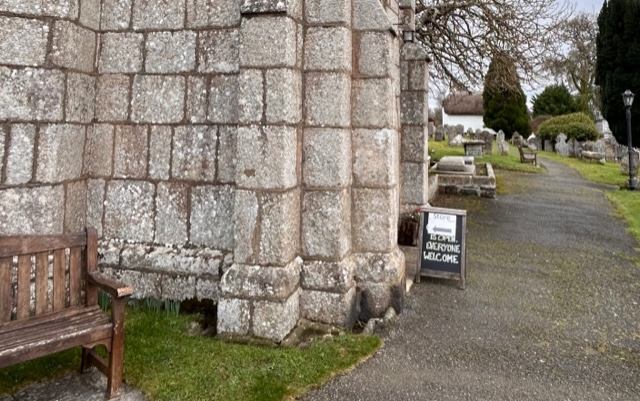
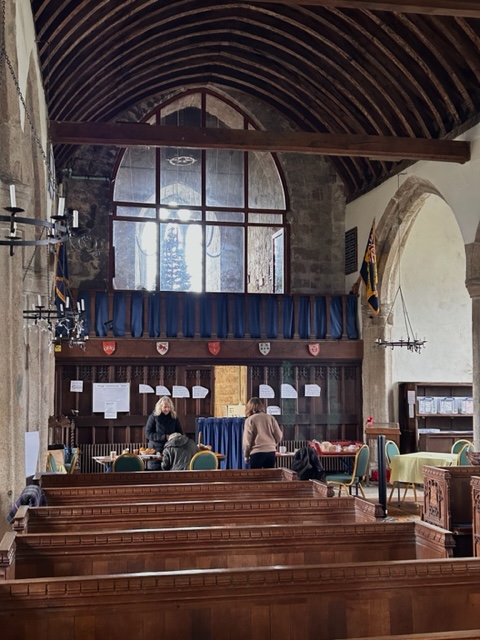
Surprisingly, there is a basic, pop-up “store” in the church. I wondered why the church would need to operate such a venture when there’s a large village store? Maybe it offers bargain-priced groceries to those who struggle to pay the store’s prices?
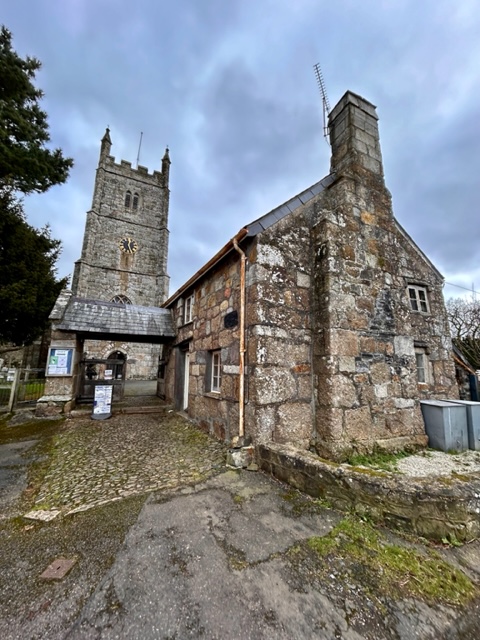
Next to the church is the 16th century Church House: originally used for church ale brewing, it became a school and is now the village hall. Before 1800 the village supported three inns and a number of ale houses and sounded like my kind of town. Alas, now there is only one pub, but it is a fine one.
The Drewe Arms is now community owned and was being renovated when we visited in February 2024: it is due to open in the Spring. Previously known as the Druids Arms, the name changed in the 1920’s when Castle Drogo was built by Mr Drewe. From 1919 it was managed by Mabel Mudge, who retired at the age of 99 in 1994, with the distinction of not only having a memorable name but also being the oldest landlady in the country.
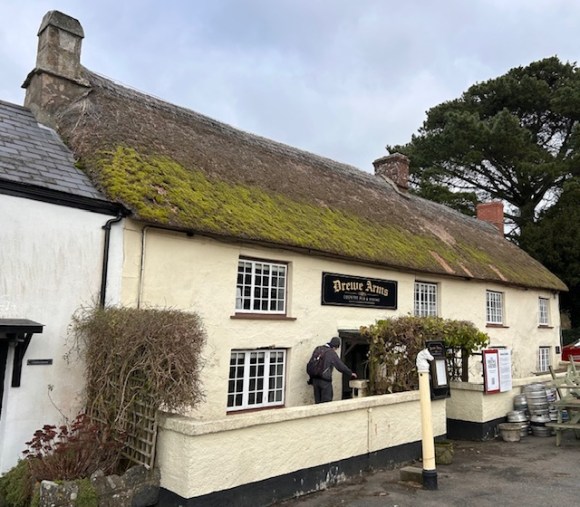
The pub was built in the 17th century and modernised in the 19th. There had been no further modernisation since then and some of the old original woodwork remained. It is to be hope that the new owner’s will respect the pub’s history and not ruin it: I’m hopeful that, being local people, their hearts are in the right place and they will manage this valuable community asset responsibly.
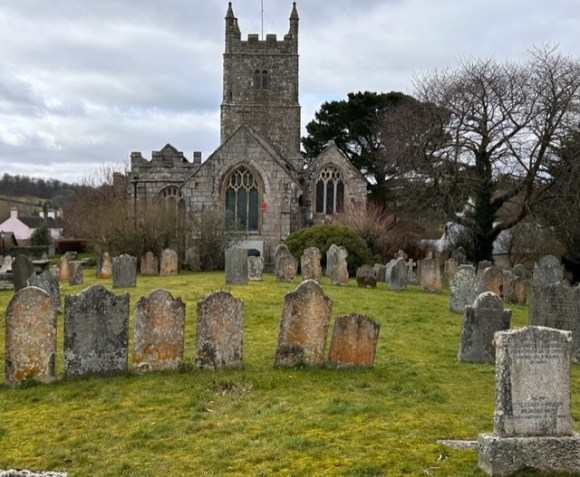
After a sit in the peaceful churchyard we begin the last lap to Fingle Bridge, with an unavoidable stretch of road walking. We follow the road that heads eastwards alongside the church, then the right fork (SX737908) to head down towards the valley floor. There is respite from road walking when we take a footpath to the right (SX744906) with a new sign indicating Fingle Bridge. This is an excellent descending path that re-joins the road, from where we turn right and make our way back to the car……. and the pub.
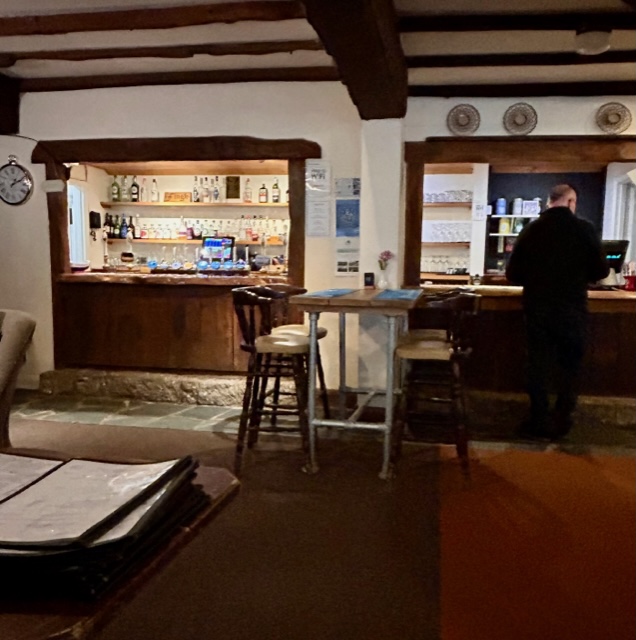
The Fingle Bridge Inn was a tea shelter in the early 20th century and an inn was built in 1957. It was originally called The Anglers Rest before being extended and becoming the Fingle Bridge Inn we enjoy today. If fine, the terrace above the river is a great place to sip a pint and reflect on a walk well done: but sadly on the February day we were there the terrace was empty and we sat inside to eat (Brixham) fish and chips washed down with a pint of Teignworthy Black Dog ale. Both food and drink were excellent.
The principal sources I’ve used in researching this series of Dartmoor OTHHs are set out in the introductory blog.
DISCLAIMER
I can take no responsibility for any loss or injury caused by following the above walk. The description is an accurate outline of the route and should enable you to follow the walk on an OS map, but the walk should not be attempted without a map, compass and the ability to use them!
Discover more from Over the hill - on Dartmoor & in Lakeland. I
Subscribe to get the latest posts sent to your email.
 Over the hill - on Dartmoor & in Lakeland. I
5 replies on “OVER THE HILL HIKES DARTMOOR #1”
Sounds like a really interesting walk Steve. If I ever get down that way again I’ll take a look but in the meantime I’ve passed it to our kid in Plymouth 👍
LikeLike
Some walking blogs can be a bit dull. But not Steve’s. Humorous, informative and practical. Makes you want to be out there, slipping down slippery slopes, taking in the splendid scenery and quaffing a pint of ale at the Fingle Bridge Inn. Who knows you might even catch a glimpse of the man himself as he ambles along some footpath, charting out another fabulous walk for us lucky folk.
LikeLiked by 1 person
Thanks for the kind words, Alastair.
Much appreciated.
You’d love the Fingle Bridge!
LikeLike
Many thanks Steve, the OTHH series of blogs/guides are a pleasure to read. Very professionally produced, easy to follow and a good prompt to enjoy all that is around us. Keep it coming!
LikeLike
Thanks Steve, I can feel an “OTHH – Snowdonia” coming on in June! Looking forward to that!
LikeLike